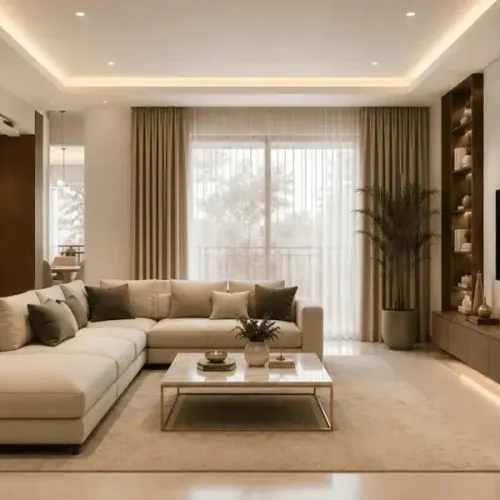
The West Direction in Vastu, known as Paschim Disha, is traditionally associated with stability, completion, fulfilment, maturity, and the results of effort. It is an important part of the Vastu framework and plays a meaningful role in the planning of homes, offices, commercial spaces, and other properties.
The West is often misunderstood because it is associated with the setting Sun. However, the setting of the Sun does not make this direction negative. Just as the East represents beginnings and rising energy, the West can symbolically represent completion, reflection, consolidation, and the results of work.
In practical architectural terms, the West also deserves careful attention because afternoon and evening sunlight can be stronger and warmer in many climates. The design of windows, shading, insulation, ventilation, materials, and room usage can therefore have a significant impact on comfort.
A West-facing house is not automatically unsuitable, just as an East-facing house is not automatically perfect. The direction of the main entrance is only one part of a complete property assessment. The plot shape, entrance position, room arrangement, natural light, slope, surrounding environment, and relationship between all eight directions should be considered together.
Understanding the West Direction in Vastu can help homeowners make more informed decisions when buying property, planning construction, arranging rooms, or addressing concerns about an existing home.
The West direction is known as Paschim Disha in Sanskrit and traditional Indian systems of spatial planning. The word Paschim refers to the West, the direction associated with the setting Sun.
Symbolically, the West represents qualities such as:
The West is often considered a direction of receiving the outcomes of effort. This does not mean that success is guaranteed simply by occupying or facing the West. Rather, the symbolism reflects the idea that growth and achievement eventually need stability, structure, and the ability to preserve results.
In modern property planning, the West can also be understood through practical factors such as afternoon heat, privacy, building protection, and the management of natural light.
Lord Varuna and the West Direction
Traditional Vastu associates the West with Lord Varuna, the deity connected with water, cosmic order, depth, and the vastness of the natural world.
This association gives the West symbolic qualities such as:
The connection with Varuna does not mean that every West zone should contain a water feature. A water element should never be added simply because of a general directional association. The complete Vastu layout, drainage, moisture control, and practical design must be considered.
Saturn and the West
Some Vastu traditions associate the West with Saturn (Shani). Saturn is traditionally connected with patience, discipline, responsibility, endurance, and long-term results.
From a practical perspective, these qualities can be interpreted through the importance of:
The symbolism of Saturn reinforces the idea that the West is not necessarily about quick results. It is often connected with stability and the ability to sustain what has already been built.
The West is traditionally connected with qualities of water, depth, movement, and adaptability, particularly through its association with Varuna in Vastu traditions.
However, the five elements of Vastu should not be understood as isolated zones with rigid boundaries. Every property contains Earth, Water, Fire, Air, and Space, and these elements interact with one another throughout the built environment.
The West may therefore be considered through qualities such as:
In practical terms, the West should also be planned according to sunlight, heat, ventilation, moisture, and the requirements of the room being placed there.

The West is traditionally connected with stability, achievement, fulfilment, relationships, and the ability to preserve results.
Results and Recognition
The West is sometimes associated with the outcomes of long-term effort.
For professionals and business owners, this may symbolically relate to:
However, real-world success always depends on skills, decisions, effort, market conditions, and many other factors.
Stability
A balanced West may support a sense of permanence and continuity.
In practical terms, this can be reflected through:
Emotional Maturity
The West’s traditional association with reflection and completion may also connect symbolically with emotional maturity and the ability to process experiences.
A comfortable West zone can contribute to a calm and private environment when properly designed.
Family and Relationships
Depending on the room and overall layout, the West may support spaces associated with family interaction, shared activities, and stability.
The actual impact depends far more on the quality of communication, the comfort of the space, and the people using it than on direction alone.
Kitchen
The South-East is traditionally preferred for the kitchen because of its connection with the Fire element. However, kitchens may exist in the West in many modern homes and apartments.
If the kitchen is already located in the West, focus on:
A kitchen should not be demolished simply because it does not match a general directional preference.
Children’s Bedroom
The West may be considered for a child’s or teenager’s bedroom in some traditional layouts.
However, the suitability should also be assessed through practical factors such as:
If the room becomes excessively hot in the afternoon, suitable shading and ventilation should be prioritised.
Bedroom
The West may be suitable for certain bedrooms, particularly where privacy and stability are important.
The exact suitability depends on:
A kitchen should not be demolished simply because it does not match a general directional preference.
Guest Bedroom
The West can be considered for a guest bedroom depending on the complete layout.
A comfortable guest room should provide:
If the room becomes excessively hot in the afternoon, suitable shading and ventilation should be prioritised.
Dining Area
The West may be suitable for dining areas in certain layouts.
The space should have:
A kitchen should not be demolished simply because it does not match a general directional preference.
Pooja or Meditation Room
The North-East and East are commonly considered suitable for pooja or meditation spaces in many traditional Vastu layouts.
A West pooja room should be assessed within the context of the entire property rather than judged solely by direction.
The space should remain:
Living Room
A living room in the West can be suitable depending on the overall floor plan.
Because western rooms may receive strong afternoon or evening sunlight, attention should be given to:
A well-designed West living room can be warm, comfortable, and inviting.
Staircase
The West may accommodate heavier structural features such as a staircase in certain layouts.
The staircase should be planned according to:
If the room becomes excessively hot in the afternoon, suitable shading and ventilation should be prioritised.
Office or Work Area
A West-facing office or work area can be suitable for certain professions and layouts.
If the space receives strong afternoon sunlight, blinds or external shading may be useful. The desk should be positioned to support comfortable work and avoid glare on screens.
The ideal working direction should be considered in relation to the individual’s role and the complete room arrangement.
Bathroom
A bathroom in the West should be evaluated through its exact location, drainage, ventilation, moisture control, and relationship with other rooms.
The direction alone does not determine whether the space is suitable.
Overhead Water Tank
The placement of an overhead tank must primarily follow structural engineering requirements.
Traditional Vastu considerations may also be taken into account, but safety and structural integrity should always come first.
Parking
Parking can be placed in the West depending on the plot layout and access requirements.
It should not unnecessarily block important entrances, reduce ventilation, or create difficult movement around the property.
Garden and Open Spaces
A West garden or outdoor area can be designed successfully with appropriate planning.
Because the West may receive strong afternoon sunlight, consider:
Plants should be selected according to the local climate and maintained properly.
Many traditional recommendations for the West can be understood through practical environmental design.
Western areas may experience stronger afternoon heat. As a result:
A West room may therefore work very well when its design responds to the local climate.
The direction also often benefits from a sense of structure and privacy. Furniture, storage, and room usage should be arranged so that the space feels organised rather than congested.
The aim is not to completely block the West. It is to manage light, heat, privacy, and movement intelligently.

Traditional Vastu recommendations for the West often favour colours that create a sense of balance, maturity, and stability.
Suitable options may include:
The choice should depend on the room’s natural light and purpose.
For example, a West-facing room that receives strong afternoon light may benefit from softer, cooler neutrals. A darker West room may benefit from lighter shades that improve visual brightness.
Suitable materials may include:
A luxury interior does not need excessive decoration. A balanced palette with quality materials can create a sophisticated result.
Traditional Vastu interpretations sometimes associate an imbalanced West with:
These should not be treated as definitive evidence of a Vastu defect.
A person’s career, health, relationships, finances, and emotional state can be influenced by many factors. A responsible Vastu assessment should consider the complete property and the actual circumstances of the occupants.
The West is neither automatically good nor bad. It is an important direction associated traditionally with stability, completion, maturity, and results. The suitability of a West-facing property depends on its complete layout, entrance position, plot shape, room placement, and surrounding environment.
A West-facing house can be suitable when properly planned. The direction of the entrance alone does not determine the quality of a property. The exact entrance location, internal layout, natural light, ventilation, plot shape, and relationship between all directions should be considered.
Living rooms, dining areas, guest bedrooms, certain children’s bedrooms, and selected work areas may be suitable in the West depending on the overall layout. The room’s purpose, occupant, natural light, temperature, and ventilation should also be considered.
Cream, beige, white, light grey, soft yellow, and selected earthy tones may work well in the West. The best colour also depends on the room’s natural light, heat exposure, interior style, and overall colour palette.
Avoid unnecessary clutter, broken items, poorly maintained structures, and objects that block essential ventilation or movement. Water features should not be added automatically without considering drainage, moisture, maintenance, and the overall property layout.
Practical options may include improving shading, ventilation, lighting, furniture placement, decluttering, colour selection, room usage, and maintenance. The appropriate remedy depends on the specific issue and the complete floor plan.
No. A West-facing entrance is not automatically problematic. Its exact position, approach, door placement, surrounding environment, and relationship with the internal layout are more important than simply labelling the property as West-facing.
Yes. Apartments can be assessed using practical Vastu principles even when structural changes are limited. Furniture arrangement, natural light, ventilation, colours, room usage, shading, and decluttering can often be improved without major renovation.
The West Direction in Vastu (Paschim Disha) represents stability, maturity, completion, fulfilment, and the ability to preserve the results of long-term effort. Its traditional association with Lord Varuna and qualities of depth and adaptability gives the direction an important place in Vastu Shastra.
The West is not a direction to fear. Nor should it be treated as automatically suitable without proper assessment.
A well-designed West zone should balance natural light, afternoon heat, ventilation, privacy, movement, and appropriate room usage. Practical design choices such as shading, insulation, comfortable colours, good airflow, decluttering, and suitable furniture placement can often make a significant difference.
The most important principle is to consider the entire property as one connected system. A direction cannot be assessed in isolation from the other seven directions, the plot, the building structure, the occupants, and the way the space is actually used.
If you are planning a new home, considering a West-facing property, designing a commercial space, or concerned about a specific Vastu issue, professional guidance can help you make decisions based on the complete layout rather than isolated rules.
Your Vastu Experts can help you understand the role of the West direction within your property’s broader spatial arrangement and suggest practical Vastu solutions suited to your specific requirements.
Book a personalised consultation with Your Vastu Experts for practical, personalised Vastu guidance based on your property’s orientation, layout, and individual needs.
Explore the Other Directions in Vastu
The West is one part of a property’s complete directional framework. Explore the remaining directions to understand how each zone contributes to the broader principles of Vastu Shastra and spatial planning.
Any trademark, brand name, or logo displayed on this website is solely for informational purposes to provide accurate and up-to-date details about the respective brand. Displaying such content does not imply any affiliation, endorsement, or partnership with the brand. All trademarks, names, and logos remain the property of their respective owners.
Transform your home and workspace with the power of Vastu. Our expert consultations help you align your environment for health, prosperity, and peace of mind.
© Your Vastu Experts
WhatsApp us